Digital internships: how to get real work experience when nobody will give you a first job
What digital internships are, why they work, and the 9 best virtual internship platforms for UK and US students and grads. Free options included.
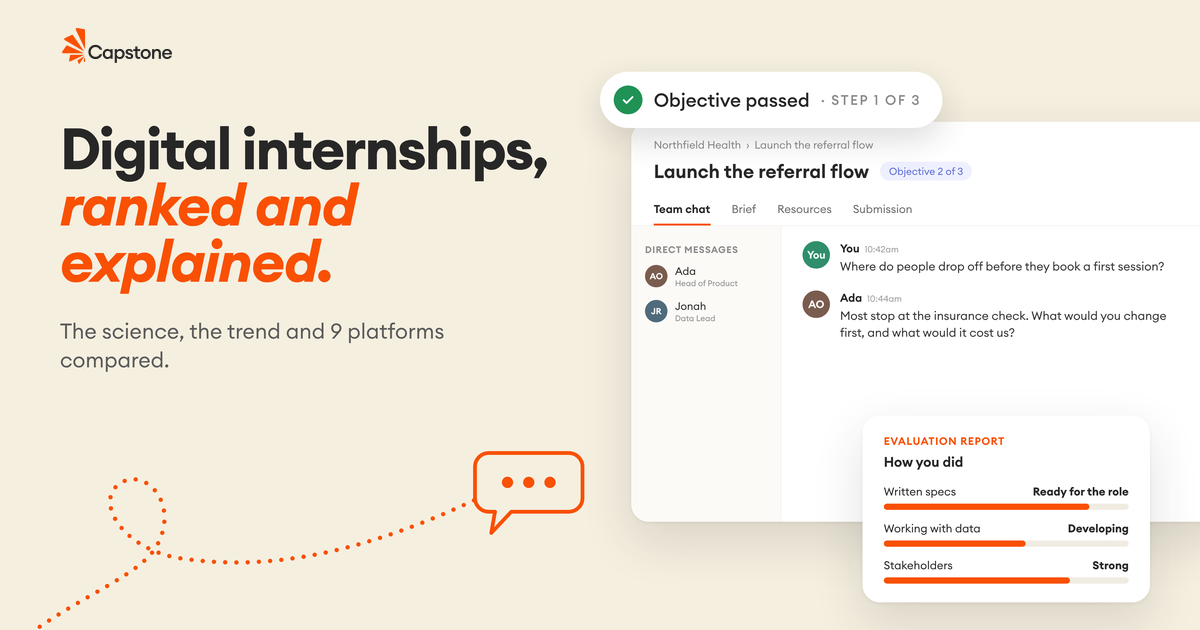
A digital internship lets you do real work online and come away with proof you can show. Here's what the research says about why they work, why demand has jumped in the UK and US, and the best virtual internship platforms to compare in 2026.
You've sent the applications. You've tailored the CV. And every second ad still asks for experience you can't get until somebody hires you. Digital internships are one of the few ways out of that loop. You do real work, from your laptop, and finish with something an employer can look at. This guide covers what they are, the science behind why they work, why they matter more this year than ever, and which platforms are worth your time.
What is a digital internship?
A digital internship is work experience you complete online. You take on tasks that mirror a real role, for a real employer or a simulated company, and you finish with evidence that you did the work.
You'll also see it called a virtual internship, an online internship, a remote internship or virtual work experience. The names overlap a lot. What actually differs is the format, and the format decides what you get out of it.
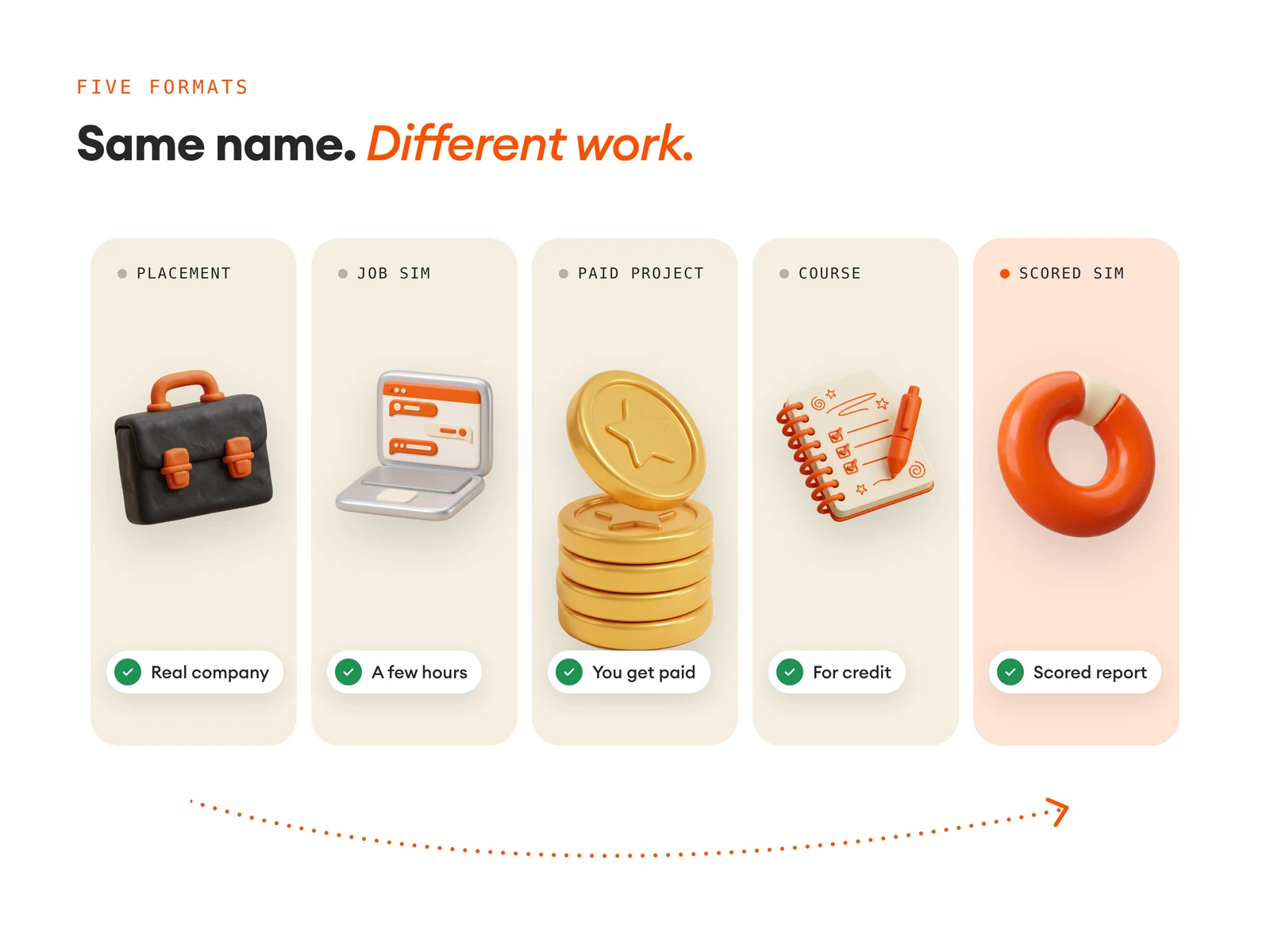
Format | What it looks like | Who sets the work | Typical cost to you |
|---|---|---|---|
Remote internship placement | You join a real company's team part-time from home for weeks or months | A host company | Often a programme fee unless your university covers it; usually unpaid |
Job simulation | Short, self-paced tasks designed by a well-known employer | The employer | Usually free |
Micro-internship | A short, paid project for a real company | The company | You get paid |
Course-embedded project | A real employer brief done as part of a module | Your lecturer and an employer | Covered by your course |
Scored work simulation | You work inside a simulated company with a team, hand in real deliverables and get graded | The platform | One-off fee, often with a free start |
None of these is automatically better. A job simulation is a great first look at a company. A placement puts a real employer on your CV. A scored work simulation gives you a full role's worth of practice and a report that says how you did. Plenty of people do more than one.
Why digital internships matter more in 2026
More people want work experience, fewer employers are offering it, and the first rung of the career ladder is moving. Here's what the numbers say.
Applications are up and places are down
In the UK, the Institute of Student Employers surveyed 155 large employers for its latest Student Recruitment Survey, published in October 2026. Applications for university-level internships rose 27% in 2025-26, while internship and placement hiring fell 8% (Times Higher Education). Graduate roles drew 141 applications each on average, and 172 in London.
The US picture is similar. Handshake reported that full-time job postings on its platform fell more than 16% year on year to August 2025, while applications per job rose 26% (WSJ via To Vima).
AI is changing the first rung
Researchers at the Stanford Digital Economy Lab used payroll data covering millions of US workers. In their November 2025 version, workers aged 22 to 25 in the most AI-exposed jobs saw a 16% relative drop in employment, while older workers in the same jobs held steady (Stanford Digital Economy Lab). Their August 2026 update found no sign of economy-wide job losses, but the gap for young workers had kept widening, mostly because companies were hiring fewer of them.
In plain terms, the tasks graduates used to learn on are often the first ones AI picks up. That makes structured practice somewhere else more valuable.
Traditional internships aren't open to everyone
The Sutton Trust found that 51% of UK graduates aged 21 to 29 have done at least one internship, up from 39% in 2018. But 61% of those internships were unpaid or paid below minimum wage, and the Trust estimated that living in London while unpaid cost at least £1,093 a month at 2020 prices (Sutton Trust). Only 36% of working-class graduates had done an internship, against 55% of middle-class graduates.
Digital formats take away the rent, the commute and the need to know someone. That's a big part of why they've grown.
Universities are being asked to scale it
Universities UK wants every undergraduate to have access to meaningful work-based learning by 2035, with half reaching it by 2030. With employers cutting placements, universities can't hit that through traditional internships alone. Digital internships and work simulations are one of the few options that scale to a whole cohort. (If you work in a careers service, our universities page explains how this works with Capstone.)
The science: why learning by doing works
Most people already sense that you don't get good at a job by reading about it. The research backs that up, and it also tells you what to look for in a programme.
Doing beats listening
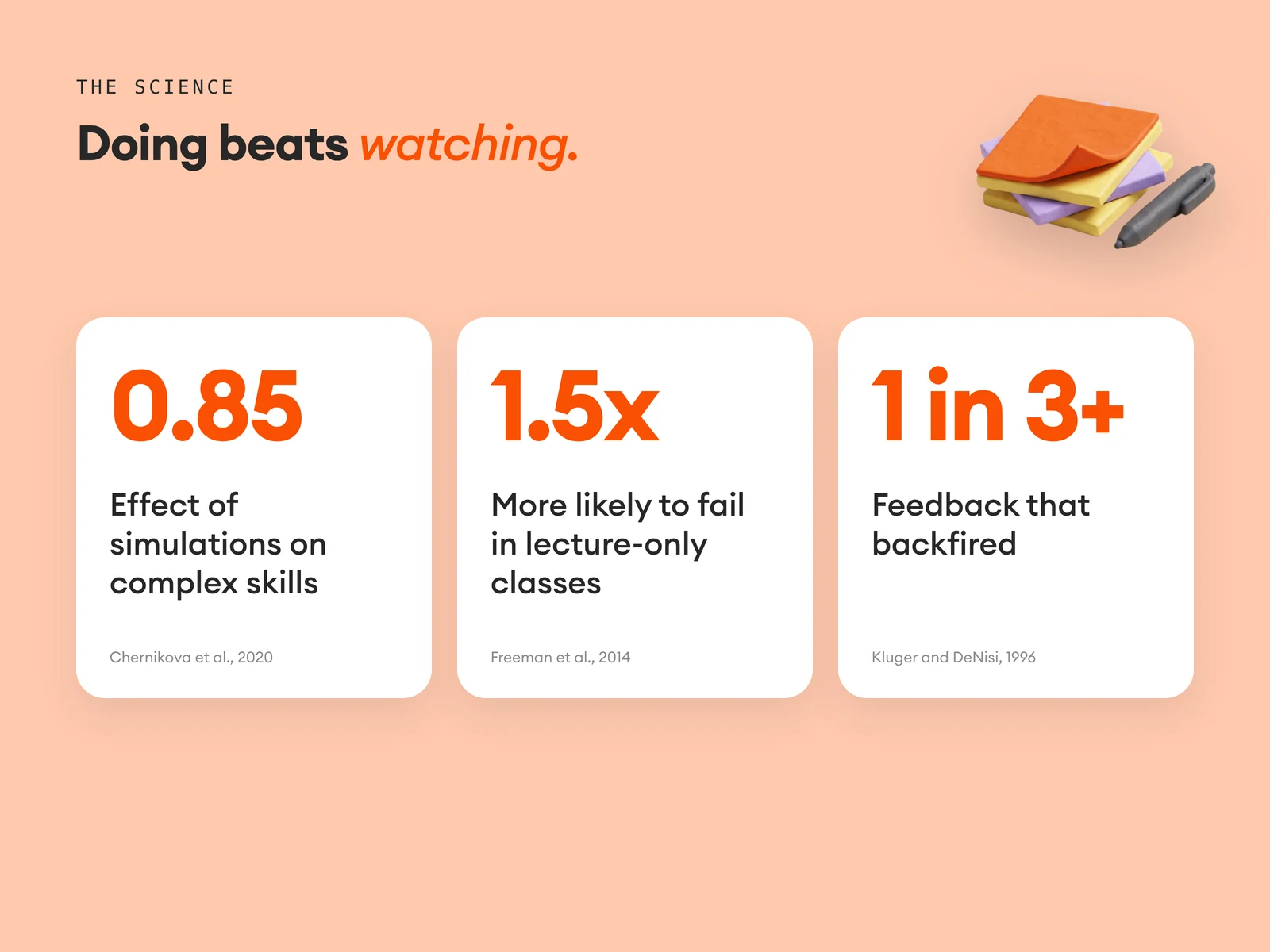
A large review in PNAS pulled together 225 studies comparing lectures with active learning in university science and maths courses. Students in lecture-only classes were 1.5 times as likely to fail, with failure rates of about 34% against 22% (Freeman et al., 2014). Those were science classes, but the principle travels. When you have to produce something, you learn more than when you watch someone else do it.
Simulations are among the most effective ways to learn complex skills
A 2020 meta-analysis in the Review of Educational Research looked at 145 studies of simulation-based learning in higher education. Simulations had a large positive effect on learning (g = 0.85), and the result held across fields as different as medicine, teacher education and management (Chernikova et al., 2020). The authors concluded that simulations are among the most effective ways to build complex skills.
Realism matters
A follow-up analysis by the same group found that authenticity plays a real part. When the tasks in a simulation look like tasks from real working life, people learn more from them (TUM). So when you compare programmes, check whether the work looks like the job you want.
Feedback is where the learning happens, if it's about the work
Feedback doesn't always help. A classic meta-analysis of 607 effect sizes found that feedback improved performance on average, but more than a third of feedback interventions actually made performance worse. Feedback lost its power when it pulled attention away from the task and onto the person (Kluger and DeNisi, 1996).
That has a practical meaning. "Great job!" teaches you very little. "Your launch plan never says how you'll price the premium tier" teaches you a lot. Look for programmes that give feedback on what you actually handed in.
Employers respond to experience
In a large résumé experiment, economists sent fictional applications to real job ads. Applicants with internship experience got 14% more interview invitations, and the boost was bigger for people outside business degrees (Nunley et al.). In the US, NACE reports that employers converted 63.1% of their 2024-25 interns into full-time hires, a five-year high (NACE).
Those numbers are for traditional internships. A digital internship won't get you the same callback by default. What it gives you is the material: real work to describe, decisions to explain and feedback you've acted on.
What this means when you pick a programme
Put the research together and a good digital internship has five things:
You produce real outputs, such as a plan, an analysis or a brief, and you don't just watch videos.
Someone pushes back on your thinking, the way a manager or colleague would.
Feedback points at the work itself and tells you what to change.
The tasks look like the job you're aiming for.
You leave with evidence an employer can check.
Do virtual internships count as real experience?
Yes, as long as you're honest about what they were. Employers care about what you did and whether you can explain it. A virtual internship you can talk about in detail beats an in-person one you can't.
It's worth being clear-eyed about one thing. NACE found that hybrid interns in 2023-24 received full-time offers less often than in-person interns, 56.2% against 71.9% (NJBIA, citing NACE). Building a relationship with an employer is harder through a screen. So go into a digital internship for the skills and the evidence, and treat any job offer as a bonus.
The evidence part matters more than it used to. In the ISE's latest survey, 92% of employers suspected or confirmed that students were using AI in applications (Times Higher Education). When so many cover letters read the same, a piece of real, scored work and a clear story about a decision you made stand out.
The best digital internship platforms in 2026
We build Capstone, so we've put it first. Everything else here is on the list because it's good at something, and we've tried to say plainly who each one suits. Details come from each platform's own pages and published sources as of November 2026, so check the latest terms before you sign up.
Platform | What you do | Coverage (roles and fields) | Where | Cost to you | Best for |
|---|---|---|---|---|---|
Capstone | Work inside a simulated company and get a scored report | Product management, product marketing and operations, across more than a dozen industries, from fintech and healthtech to AI, telecom, travel and media; growth marketing, customer success, cybersecurity and sales coming | Anywhere online | Free start, then a one-off fee per simulation | Students, grads and career changers practising a real role |
Forage | Short tasks designed by big employers | 300+ simulations from 100+ employers, strongest in banking, consulting, law and tech | Anywhere online | Free | A first look inside a specific company |
Virtual Internships | Remote placement with a real host company | 18 career fields, with host companies in 80+ countries | Global | Fee if you apply directly; often covered by universities | A real company on your CV |
Bright Network IEUK | Four-day virtual programme with employers | Sector streams such as technology, commercial law and the public sector; 37 employers in 2025 | UK | Free | UK students wanting employer exposure |
Springpod | Virtual work experience with UK employers | 100+ programmes across sectors such as law, healthcare, media and the public sector | UK | Free | School and college students |
Parker Dewey | Short, paid projects for companies | Open to all majors; project types depend on the company posting | US | You get paid | Paid experience in the US |
Riipen | Employer projects built into your course | Any discipline your course runs, from 44,000+ employer projects | Partner institutions | Through your course | Credit-bearing projects |
Extern | Part-time remote projects with companies | Mainly technology, finance and healthcare, with Fortune 500s to startups | Global | Varies by programme | A structured project with a mentor |
Digital Internship | Scored tasks in simulated environments | Roles not listed on the homepage; check the catalogue | Anywhere online | From $9.99 | Low-cost task practice and a portfolio |
1. Capstone: best for practising a whole non-technical role and getting scored
Capstone is virtual work experience for non-technical careers. You join a simulated company, work with your team in a shared workspace and hand in the things the job actually needs, like a product spec, an analysis or a launch plan. Your colleagues respond the way real ones do, so a vague question usually gets a question back.
When you finish, you get an evaluation report that scores both the work and how you worked with people, plus a verifiable certificate you can add to LinkedIn. Right now you can try product management, product marketing and operations, across more than a dozen industries, including fintech, healthtech, AI, edtech, telecom and travel, with more roles on the way, including growth marketing, customer success, cybersecurity and sales. Each simulation is self-paced and shows its length in the catalogue.
You pay once per simulation, with no subscription. You can do the first objective free without a card, or start a free trial of the full simulation. There's also a free AI CV review you can run against a target role.
Why we think Capstone is the strongest choice for most people
It's built around the career you want. Most platforms on this list give you a taste of one company or one sector. Capstone simulations are built around the role itself, so the skills carry to any employer hiring for it.
It's open to students and professionals alike. Many digital internships are tied to a university, a year group or a country. Capstone works the same way for a second-year student, an MBA, a recent graduate or someone switching careers at 35.
It connects you to employers of every size. Our job board brings in new roles every day from top job sites around the world, and hiring teams on Capstone post their own roles, some with a simulation attached. That means startups and growing companies as well as the big names.
The companies feel real. Each simulation is closely modelled on how real companies in that industry work: their kinds of products, customers, data and trade-offs.
The environment moves with you. Your colleagues respond to what you actually say and hand in. They push back and ask follow-up questions, so the work unfolds around your choices.
Worth knowing: it's a simulated company, so it won't put a real employer's name on your CV. The role list is focused rather than huge.
2. Forage: best for a free first look inside a well-known employer
Forage hosts free, self-paced job simulations designed by employers such as Goldman Sachs, KPMG and BCG. It lists more than 300 simulations and says over 10 million enrolments (Forage). Most take a few hours. Forage reports that students who complete a company's simulation are more than twice as likely to get an interview with that company (EAB).
Worth knowing: the tasks are short and you usually compare your work with an example answer, so expect less personal feedback. It's most useful when you plan to apply to that specific employer.
3. Virtual Internships: best for a remote placement with a real company
Virtual Internships matches you with a host company for a guaranteed remote placement in one of 18 career fields. Placements run 10 to 30 hours a week for 1 to 4 months (Times Higher Education). If you apply directly you pay an acceptance fee and a final fee, but many students take part through their university, which covers the cost (Virtual Internships FAQ). Placements are usually unpaid.
Worth knowing: your experience depends a lot on the host company you're matched with, so ask what the project and supervision will look like.
4. Bright Network Internship Experience UK: best for UK students who want employer contact
Bright Network's IEUK is a free, four-day virtual internship that runs each summer for first, second and penultimate-year students. The 2025 edition featured 37 graduate employers, including Google and Bank of America (Bright Network), and the 2026 programme ran from 15 to 18 June.
Worth knowing: it happens once a year on fixed dates, and applications close weeks beforehand.
5. Springpod: best for school and college students in the UK
Springpod runs free virtual work experience programmes with employers including UK Parliament, the BBC and NHS trusts, and it's built into the UCAS Hub (UCAS). It's aimed mainly at secondary school and college students.
Worth knowing: it's designed for early career exploration, so it's less useful once you're a graduate.
6. Parker Dewey: best for paid, short projects in the US
Parker Dewey offers micro-internships: short, paid, fixed-fee projects for real companies, usually 5 to 40 hours of work. It says 91% are remote. You need to be 18 or over and a student or recent graduate of a US institution (Parker Dewey).
Worth knowing: it's US only, and popular projects attract a lot of applicants.
7. Riipen: best if your course can build it in for credit
Riipen connects educators with employers so that real projects sit inside your course. It works with more than 700 institutions and training providers (Riipen), and you usually earn credit and get employer feedback.
Worth knowing: you normally get access through a lecturer or programme, so ask your department.
8. Extern: best for a structured, part-time project with a mentor
Extern runs remote externships with companies from Fortune 500s to startups. A typical programme is part-time, around 10 to 15 hours a week, for 6 to 12 weeks, with milestones from a mentor (IE University).
Worth knowing: access often comes through university partnerships, so check eligibility and cost for your programme.
9. Digital Internship: best for low-cost task practice and a portfolio record
Digital Internship, from Vorkis LLC, gives you tasks in simulated professional environments with a mix of human and AI teammates. Each task is scored into a performance record, and you finish with a portfolio and a work completion reference. Plans start at $9.99 per learner (Digital Internship).
Worth knowing: the homepage doesn't list specific roles, so check what's available for your target career before you pay.
How to choose the right platform
Start with what you need most right now:
You want to see inside a specific big company before you apply. Try Forage.
You want a real company on your CV and your university will fund it. Look at Virtual Internships or Extern.
You're in the US and want to get paid. Look at Parker Dewey.
You're a UK student and want employer contact this summer. Apply for Bright Network IEUK.
You're still at school or college. Start with Springpod.
You want to do a full role's worth of work in the career you're aiming for and get scored on it. Try Capstone.
These stack well. A free job simulation helps you explore. A scored simulation helps you practise and prove you can do the work. A placement or micro-internship adds a real employer when you can get one. If you're not sure which role to aim for yet, our post on Capstone Pathways walks through building a step-by-step plan.
How to put a digital internship on your CV
Done well, a digital internship gives you some of the strongest lines on your CV. A few rules help.
Name it accurately. Call it "virtual work experience", "job simulation" or "virtual internship", whichever is true. Don't present a simulation as a job. Recruiters check, and honesty reads well.
Lead with what you delivered. Name the output, the problem it solved and one decision you made.
Add the evidence. Link your report, certificate or portfolio so a recruiter can check in one click.
Prepare one story for interviews. Pick a moment where you had to trade something off, and say what feedback you got and what you changed.
Here's an example for a product marketing simulation:
Product marketing simulation, Capstone (Fintech), 2026
Wrote the launch plan for a new savings feature, covering positioning, target segments and a pricing risk review. Reworked the messaging after stakeholder pushback on the main claim. Verified certificate and evaluation report linked.
Want a second opinion? Run your CV through our free AI CV review against the role you're targeting.
FAQ
FAQ
- What's the difference between a virtual internship and a job simulation?
A virtual internship usually means a remote placement with a real company for weeks or months. A job simulation is a set of tasks that mirror a role, either designed by an employer or set inside a simulated company. Simulations are more flexible and easier to get into. Placements put a real employer's name on your CV.
- Are virtual internships worth it?
They are when you produce real work, get specific feedback and leave with evidence you can show. Research on simulations and learning by doing supports that. They're less useful if all you do is watch videos and collect a certificate.
- Are digital internships paid?
Most aren't. Job simulations are usually free or low cost, remote placements are often unpaid, and some carry a programme fee. Micro-internships, such as those on Parker Dewey, are the main paid option.
- Can international students do a virtual internship?
Usually, yes. Simulations and job simulations are open to anyone online. Paid projects and some placements depend on where you study and whether you can legally work, so check the eligibility rules before you apply.
- How long does a digital internship take?
It depends on the format. Forage simulations often take a few hours, Bright Network's IEUK runs over four days, and Virtual Internships placements last 1 to 4 months. Capstone simulations are self-paced, and each one shows its length in the catalogue.
- What are the best free virtual internships?
Forage, Bright Network IEUK and Springpod are free. Capstone lets you do the first objective of a simulation free without a card, and its AI CV review is free too.
Get started
If you've been stuck in the experience loop, the fastest way out is to do the work and keep the proof. Start a Capstone simulation, pick a role and do your first objective free. As one of our early readers, you can use the code LAUNCH26 for 20% off simulations and pathways until 31 December 2026.
For more on how a simulation works day to day, read Get real work experience before anyone hires you. If you're in the UK and weighing up your options, our companion guide to virtual work experience goes deeper on UK programmes.
We'd love to know what you're looking for in a digital internship that you haven't found yet. Tell us on our feedback page.
Sources
Institute of Student Employers, Student Recruitment Survey, reported by Times Higher Education, October 2026
Brynjolfsson, Chandar and Chen, Canaries in the Coal Mine?, Stanford Digital Economy Lab, 2025, revised 2026
Holt-White and Cullinane, Unpaid and Underpaid Internships, Sutton Trust, January 2025
Freeman et al., Active learning increases student performance in science, engineering, and mathematics, PNAS, 2014
Chernikova et al., Simulation-based learning in higher education: a meta-analysis, Review of Educational Research, 2020
Kluger and DeNisi, The effects of feedback interventions on performance, Psychological Bulletin, 1996
Nunley, Pugh, Romero and Seals, College major, internship experience, and employment opportunities: estimates from a résumé audit, Labour Economics, 2016
NACE, Intern conversion rate hits highest mark in five years, 2026