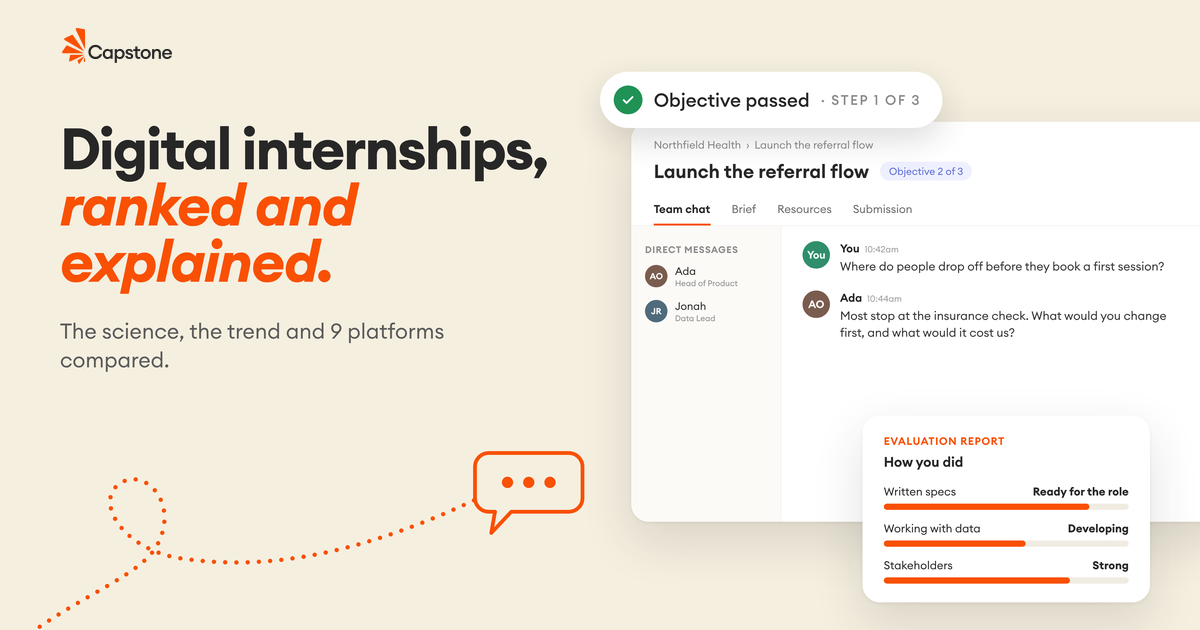
Virtual work experience: does it count, and how do you make it count?
What virtual work experience is, whether UK employers rate it, and how students, grads and career changers can pick a programme and make it count.
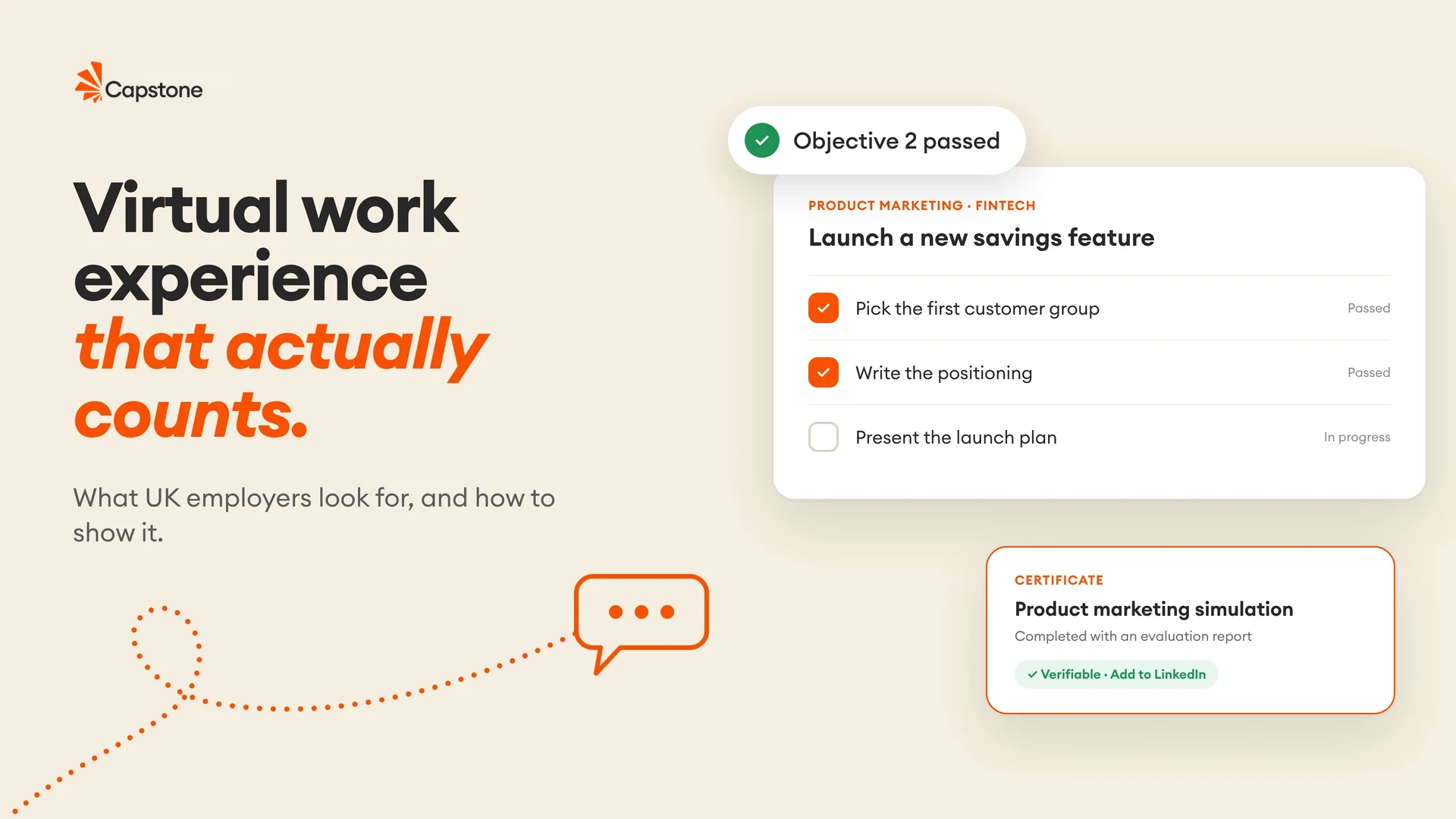
Virtual work experience has become a normal part of getting into a graduate career in the UK. Here's what it is, which kind suits your stage, what employers make of it and how to turn it into strong answers on applications.
Maybe it's second year and the summer internship rejections are piling up. Maybe you're on a one-year MSc with no placement year, or you're an international student who can't easily take a London internship. Or you've graduated and every entry-level ad still wants experience. Virtual work experience is how a lot of people in exactly that spot are getting started. This guide explains what it is, which kind fits where you are and how to make it count with UK employers.
What is virtual work experience?
Virtual work experience is work experience you complete online. You take on tasks that reflect a real role and finish with something to show for it, such as feedback, a certificate or a scored report.
"Virtual work experience" is the term most UK universities and employers use. In the US you'll more often see "virtual internship" or "digital internship". In practice it covers a few formats:
Employer job simulations. Short, free tasks designed by a company, often a few hours long.
Virtual internship programmes. Fixed-date programmes run with employers over a few days.
Remote placements. Part-time work with a real host company, sometimes funded by your university.
Scored work simulations. You work inside a simulated company with a team, hand in real deliverables and get graded.
For the research on why learning by doing works, see our full guide to digital internships.
Why UK students are turning to virtual work experience
Getting traditional work experience in the UK has become harder. The Institute of Student Employers found that applications for university-level internships rose 27% in 2025-26, while internship and placement hiring fell 8% (Times Higher Education). The year before, employers were already getting 101 applications for every internship and 123 for every undergraduate placement (ISE).
Cost is the other barrier. The Sutton Trust found that 61% of graduate internships were unpaid or paid below minimum wage, and only 36% of working-class graduates had done one, compared with 55% of middle-class graduates (Sutton Trust).
Universities feel this too. Universities UK has set a goal for every undergraduate to have access to meaningful work-based learning by 2035. With fewer placements on offer, many careers services now point students to virtual options that work at the scale of a whole year group.
Which kind of virtual work experience suits you?
The right approach depends on where you are. Capstone is built for every stage from university onwards.
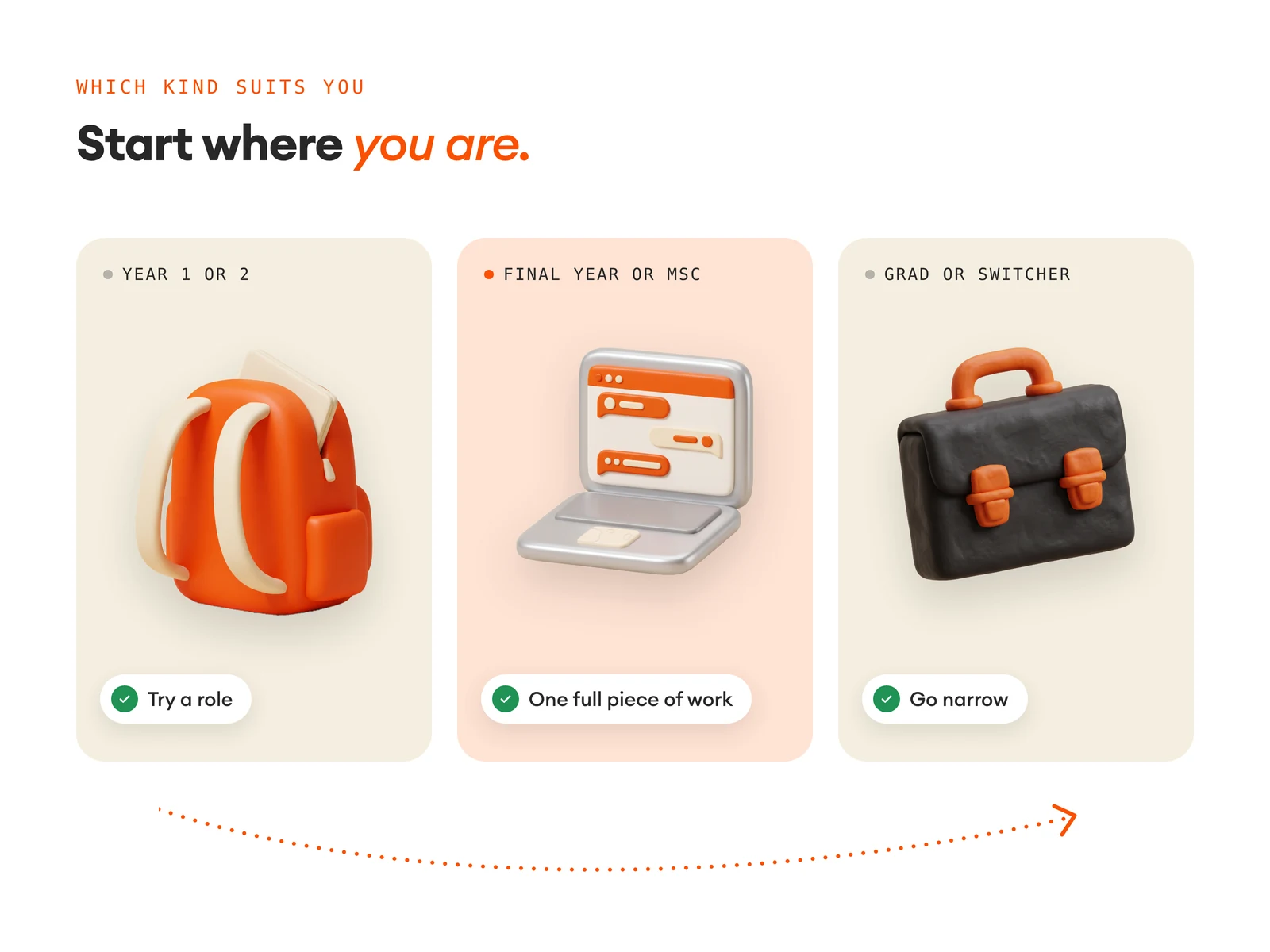
In your first or second year at university. Use a simulation to try a role before you commit to it. Doing the work of a product manager or a product marketer tells you more than any careers talk, and you finish with a report and a certificate for your first internship applications.
In your final year, on a one-year MSc or as an international student. You probably don't have a placement year, and short tasks won't give you much to talk about. A full Capstone simulation gives you a complete piece of work, feedback on it and a verifiable certificate you can use in interviews. It runs online at your own pace, so it fits around a dissertation and doesn't depend on a visa.
As a graduate or career changer. Go narrow. Pick the role you want and do work that looks like it. A scored simulation in that role gives you specific evidence and shows you where your gaps are. If you're not sure which role fits, Capstone Pathways builds you a step-by-step plan.
Does virtual work experience count?
It does, with one condition: you have to be able to show and explain what you did.
UK research supports that. A study of students, academics and employers found that online internships were seen as valid, flexible work experience that was likely to help employability (Higher Education, Skills and Work-Based Learning). The same researchers noted that people saw them as not quite equal to on-site internships, mostly because communicating and building relationships is harder online (Wonkhe). So choose programmes that make you talk to people, ask questions and handle pushback.
There's another reason evidence matters now. In the ISE's latest survey, 92% of employers suspected or confirmed students were using AI in applications (Times Higher Education). A specific story about a plan you wrote, the feedback you got and what you changed is much harder to fake, and recruiters know it.
How to make virtual work experience count
Pick one tied to the role you want. A product marketing simulation helps a product marketing application far more than a random certificate.
Treat it like a real job. Hit your own deadlines, ask good questions and write things up properly.
Act on the feedback. Specific feedback on your work is where most of the learning happens, so change something and note what you changed.
Keep the evidence. Save the report, the certificate and the work itself, and link them from your CV and LinkedIn.
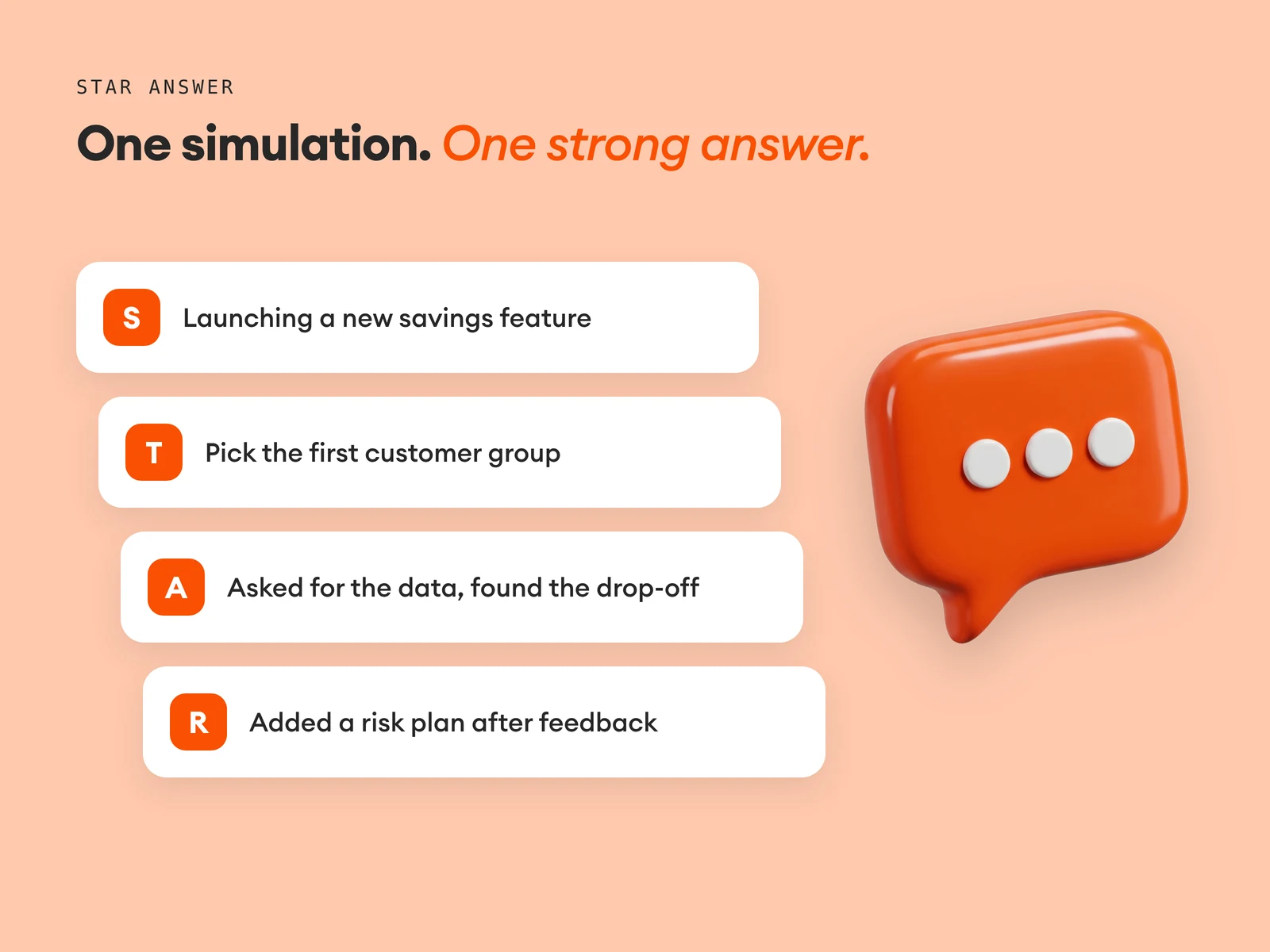
Turn it into interview answers. UK employers love competency questions. Use the STAR structure (situation, task, action, result) with one moment from your programme.
Here's what that can sound like:
"In a product marketing simulation, I had to choose which customer group to launch a new savings feature to first. I asked the data lead for sign-up numbers by age, saw that younger users dropped off at the deposit step and argued for starting with them alongside a simpler first deposit. The feedback said my case was strong but light on risk, so I added a section on what we'd do if uptake stalled."
That answer works because it names a decision, the evidence behind it and what you did with feedback.
How to get virtual work experience with Capstone
Pick a role. Browse the catalogue by role and industry. Product management, product marketing and operations are live now, across more than a dozen industries, with growth marketing, customer success, cybersecurity and sales on the way.
Start free. Do the first objective of any simulation without a card, or start a free trial of the full simulation.
Do the work with your team. You join a simulated company closely modelled on real ones in that industry, and your colleagues respond to what you actually say and hand in.
Get your report and certificate. Your evaluation report scores both the work and how you worked with people, and your verifiable certificate goes straight onto LinkedIn.
Put it to work. Our job board brings in new roles every day from top job sites around the world, and hiring teams on Capstone post their own roles too, some with a simulation attached.
If you work in a careers team, our universities page covers how Capstone fits alongside placements.
FAQ
FAQ
- Does virtual work experience count as work experience?
Yes, as long as you describe it accurately. Call it virtual work experience or a simulation, say what you delivered and link the evidence. Employers care about what you did and whether you can explain it.
- Is virtual work experience free?
You can start for free. On Capstone you can do the first objective of any simulation without a card, or start a free trial of the full simulation. After that you pay once per simulation, with no subscription, and our AI CV review is free.
- Who is Capstone's virtual work experience for?
University students, MSc and MBA students, recent graduates and career changers aiming for non-technical roles. It works the same whether you're in second year or switching careers in your thirties.
- Is a work simulation real work experience?
It's virtual work experience, and you should call it that. What makes it count is the work itself: in a Capstone simulation you hand in real deliverables and get scored on them, so you have specifics to talk about in interviews.
- How do I put virtual work experience on my CV?
Give it its own line with the programme name and year, lead with what you delivered and link your certificate or report. Our digital internships guide has an example you can adapt.
- Can international students do virtual work experience in the UK?
Yes. Capstone simulations run online at your own pace, so you can take part from anywhere, and they don't depend on a work visa.
Get started
The best virtual work experience is the one that gives you something real to talk about. Start a Capstone simulation and do your first objective free. As one of our early readers, you can use LAUNCH26 for 20% off simulations and pathways until 31 December 2026. If you're not sure your CV is telling the right story yet, try our free AI CV review.
And if there's something you wish virtual work experience did better, we'd love to hear it on our feedback page.
Sources
Institute of Student Employers, Student Recruitment Survey, reported by Times Higher Education, October 2026
Institute of Student Employers, Top 10 stats of 2025
Holt-White and Cullinane, Unpaid and Underpaid Internships, Sutton Trust, January 2025
Online internships as valid work experience, Higher Education, Skills and Work-Based Learning, 2021, and the authors' summary on Wonkhe