Watch candidates do the job before you hire them
Hiring for a non-technical role? Watch candidates do the work in a simulated company. Free to build, free for candidates, results private to you.
Updated Nov 3, 2026
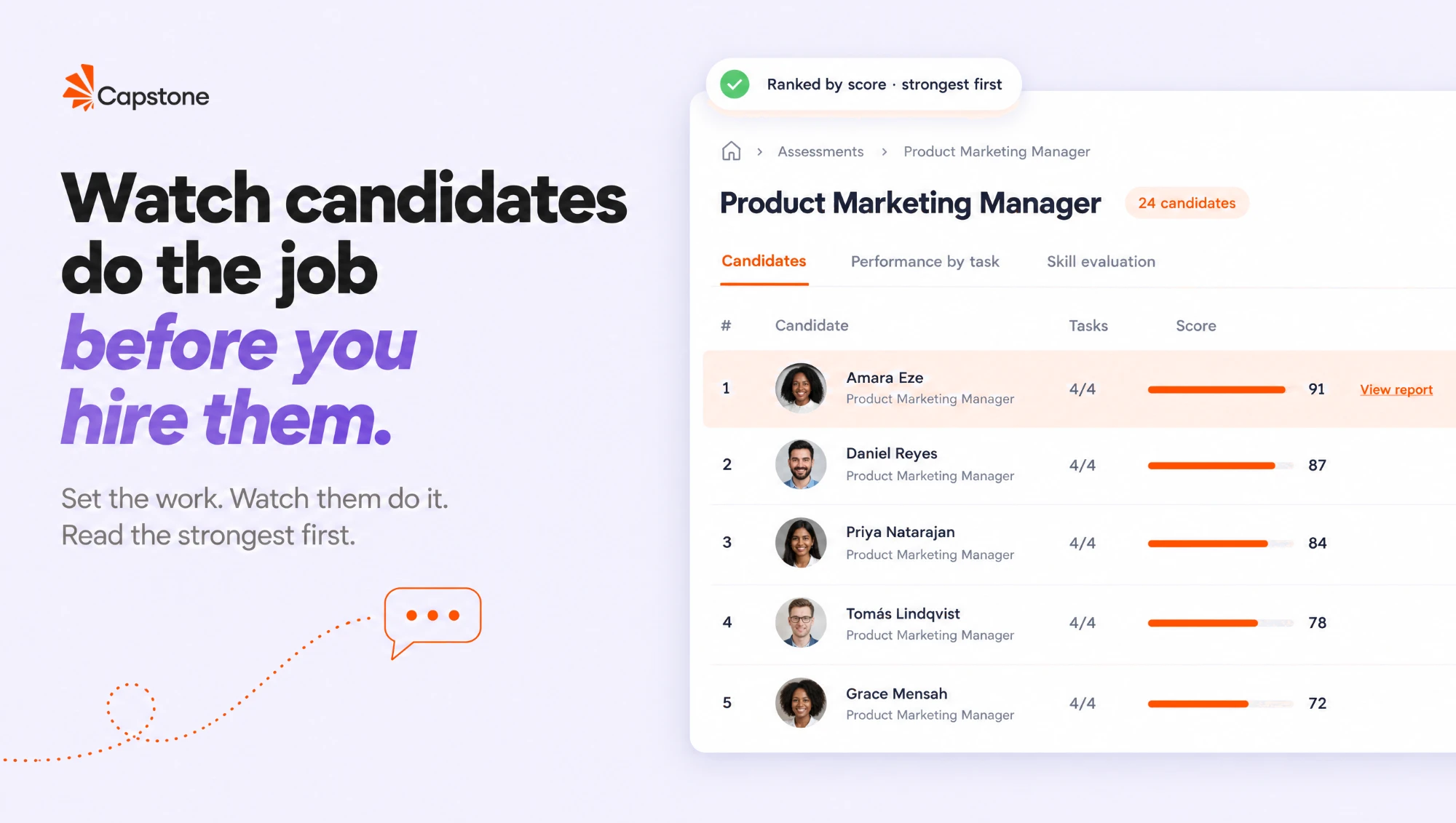
Every recruiter has a hiring story they'd rather forget.
Maybe it's the candidate with the perfect CV who couldn't actually do the work or the person who aced every interview stage, started the job, and somehow felt like a completely different person three weeks later.
Hiring is strange like that.
We spend weeks trying to predict whether someone can do a job before they've actually done any of it.
It happens because a CV is usually all you have at the start, and a CV only tells you where someone has been. It doesn’t show you how they think, how they handle a messy brief, or what they do when the plan changes halfway through.
Today we're opening Capstone to every hiring team: a work-simulation assessment that puts your candidates inside a simulated company to do real work, then scores and ranks their submissions, so you start with the strongest. Sign up with your work email on the hiring page. Building is free, candidates never pay, and a short call with us switches on invites.
What is a work simulation assessment?
A work simulation assessment asks candidates to complete a realistic piece of the job they are applying for.
Instead of answering hypothetical questions like:
"Tell me how you would handle this situation..."
they actually handle the situation.
On Capstone, candidates enter a simulated company where they have:
a team to work with
goals to achieve
information to review
tasks to complete
decisions to make
Why we built it
Capstone did not start as a hiring tool.
We originally built simulations to help people practise real workplace skills.
Instead of learning through theory alone, people could step into realistic company environments, work through challenges, and make decisions the way they would on the job.
They had a company, a team, goals, problems to solve, and work to deliver.
Over time, we noticed something interesting.
These simulations were not just helping people learn.
They were revealing how people approached problems, communicated decisions, handled ambiguity, and delivered work.
In other words, they were showing the exact things hiring teams are trying to understand.
That led us to a question:
Could the same experience that helps people practise work also help companies find people who can do that work?
That is why we opened Capstone to hiring teams.
There's also the reality that hiring can be a long, winding process. You write the brief, put it out there, read through every submission, including the ones that aren't worth your time. And these are hours that you could have spent hiring the strongest talent.
The research agrees. A 2022 re-check of decades of hiring studies found most methods predict job performance less well than people thought, but methods built around a specific job, such as work samples and structured interviews, still came out on top (Sackett et al., Industrial and Organizational Psychology, 2023).
Skills-based hiring widens the pool too. LinkedIn found that looking at skills instead of past job titles could make the pool of eligible candidates 6.1 times bigger worldwide, and 8.4 times bigger in the UK (LinkedIn Economic Graph, March 2025). That only helps with a fair way to check those skills.
We'd already built simulations where people practise non-technical roles, with the same company, brief and evaluation for everyone. So we opened them to hiring teams.
How it works
There are two ways in. Both end in a list of candidates ranked by how well they did the work.
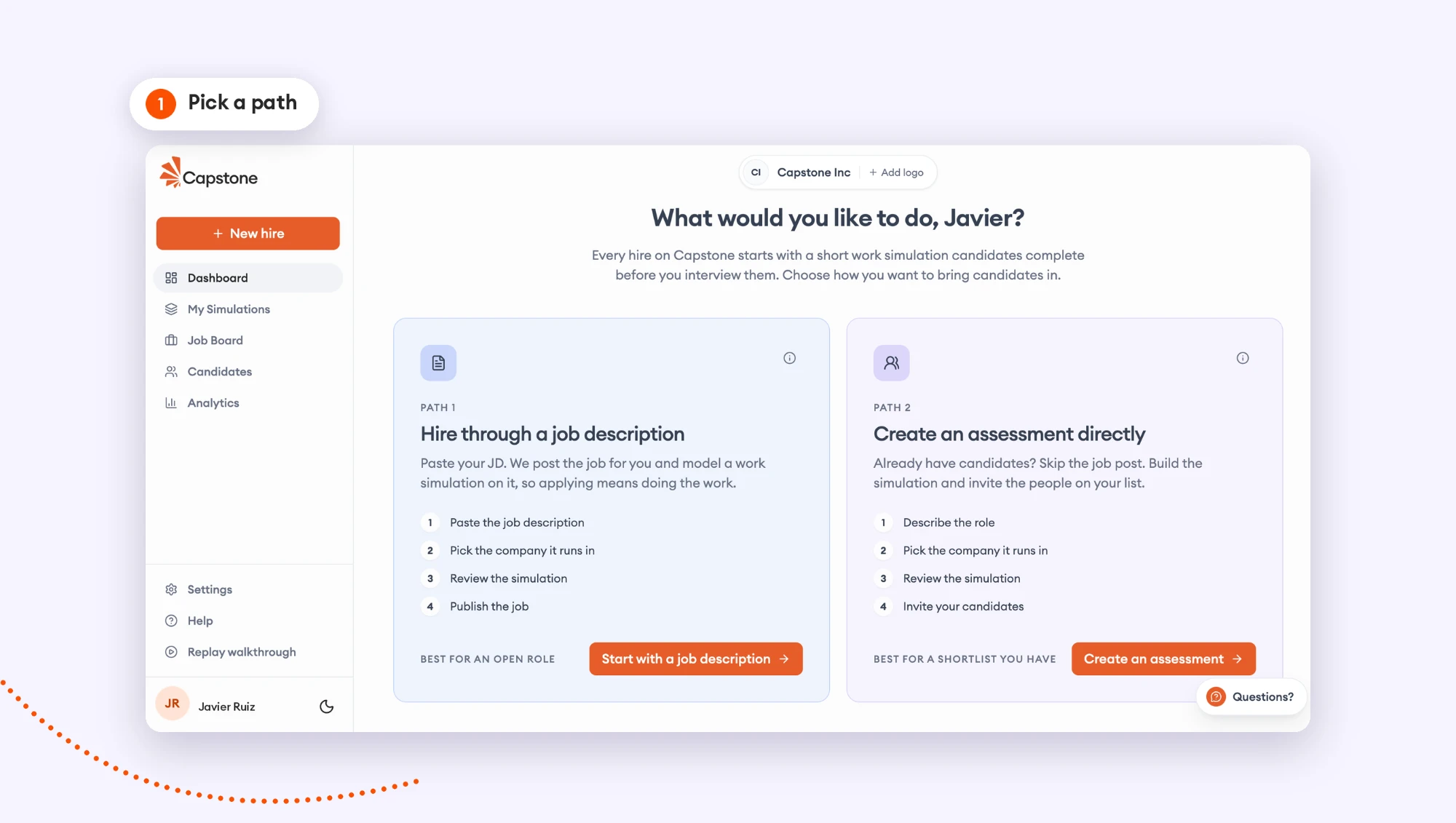
Two ways in. Hire through a job description, or assess the candidates you already have.
Path 1: Hire through a job description
This works best when you are hiring for an open role and don't have a shortlist yet.
You add your job description, choose the simulated company environment, and Capstone creates a work simulation based on the role. You can review and edit the simulation before publishing it. Once it goes live, candidates can apply and complete the assessment.
Instead of reviewing hundreds of applications and guessing who might be a good fit, you can start with candidates who have already demonstrated their ability.
Path 2: Create an assessment directly
Maybe you already have candidates from your ATS, referrals, or a recruitment agency.
You can create an assessment directly and invite specific candidates. Describe the role, select the simulation environment, review the generated tasks, and send invitations.
Only candidates you invite can access the assessment.
We draft the simulation, you edit it
Every simulation runs inside one of our ready-made companies, with a team, documents, and goals in place, and you can preview it first. AI drafts up to four tasks for your role, and you edit anything before it goes live.
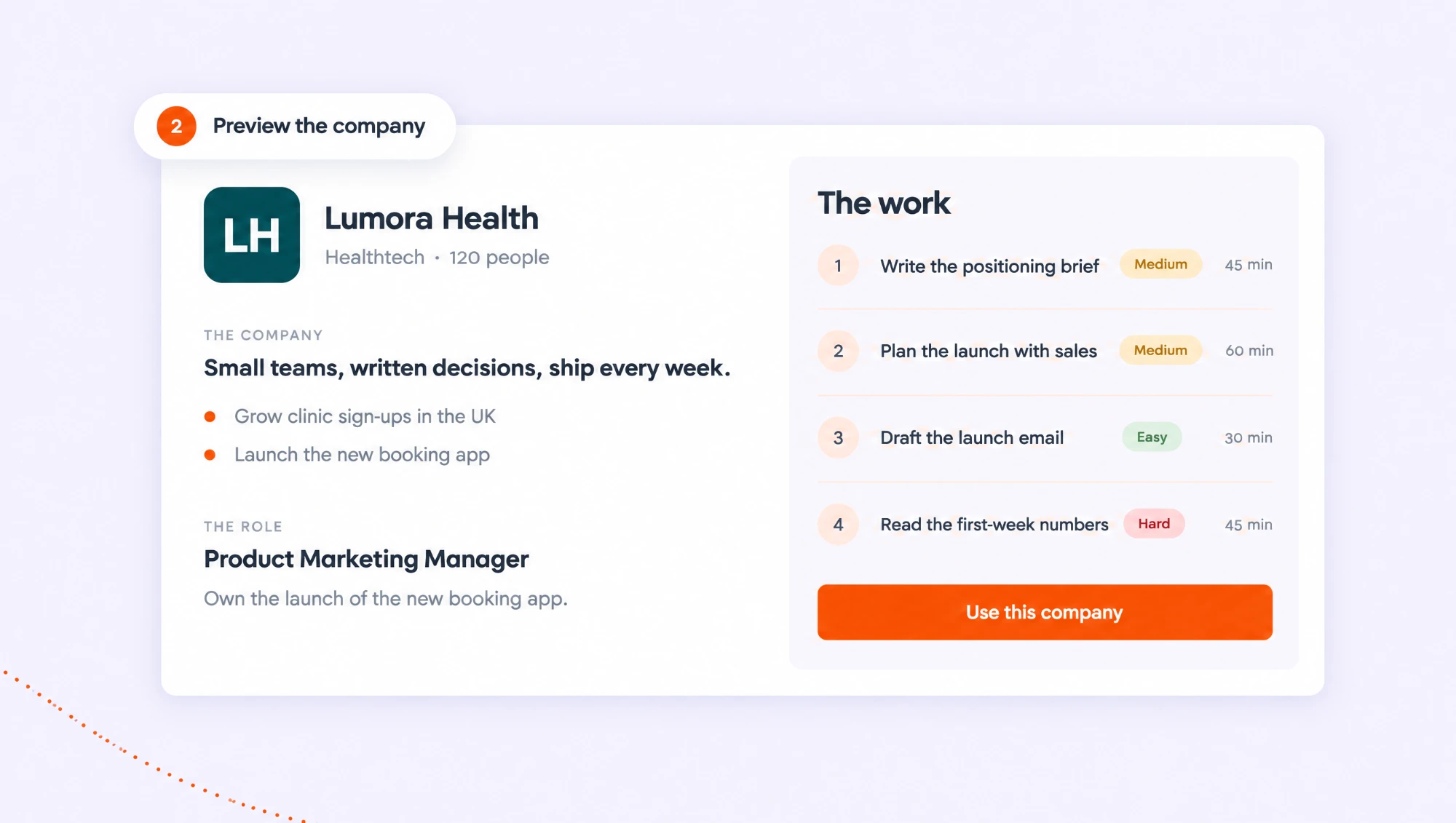
See the company, the role and every task before you pick it.
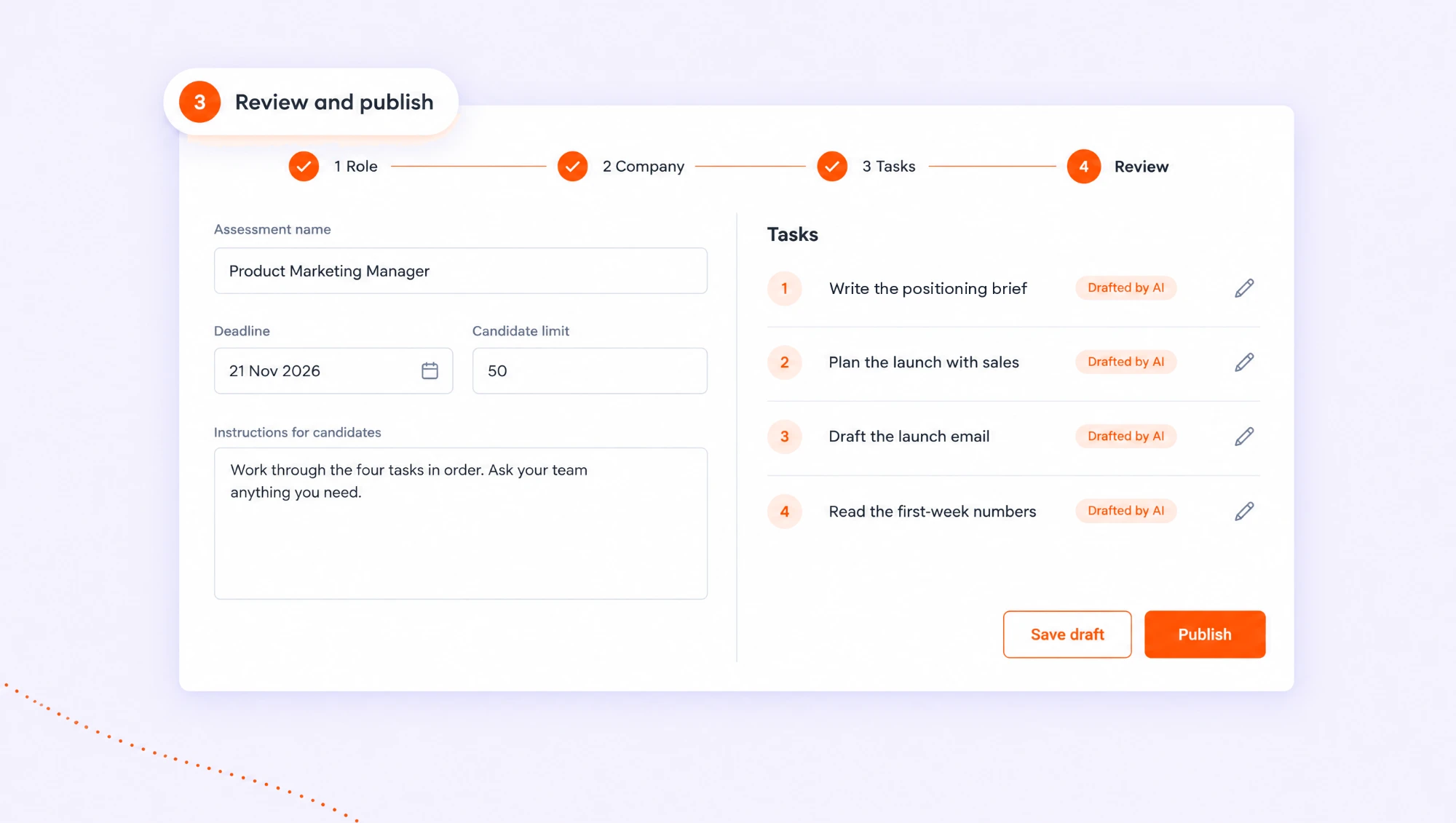
Edit the drafted tasks, deadline and instructions, then publish.
Want a simulation built around your own company instead? Email us and it's usually ready within a day.
Candidates start in a few steps
Candidates open your invite and create a free Capstone account with their name and a one-time code. No password, no fee.
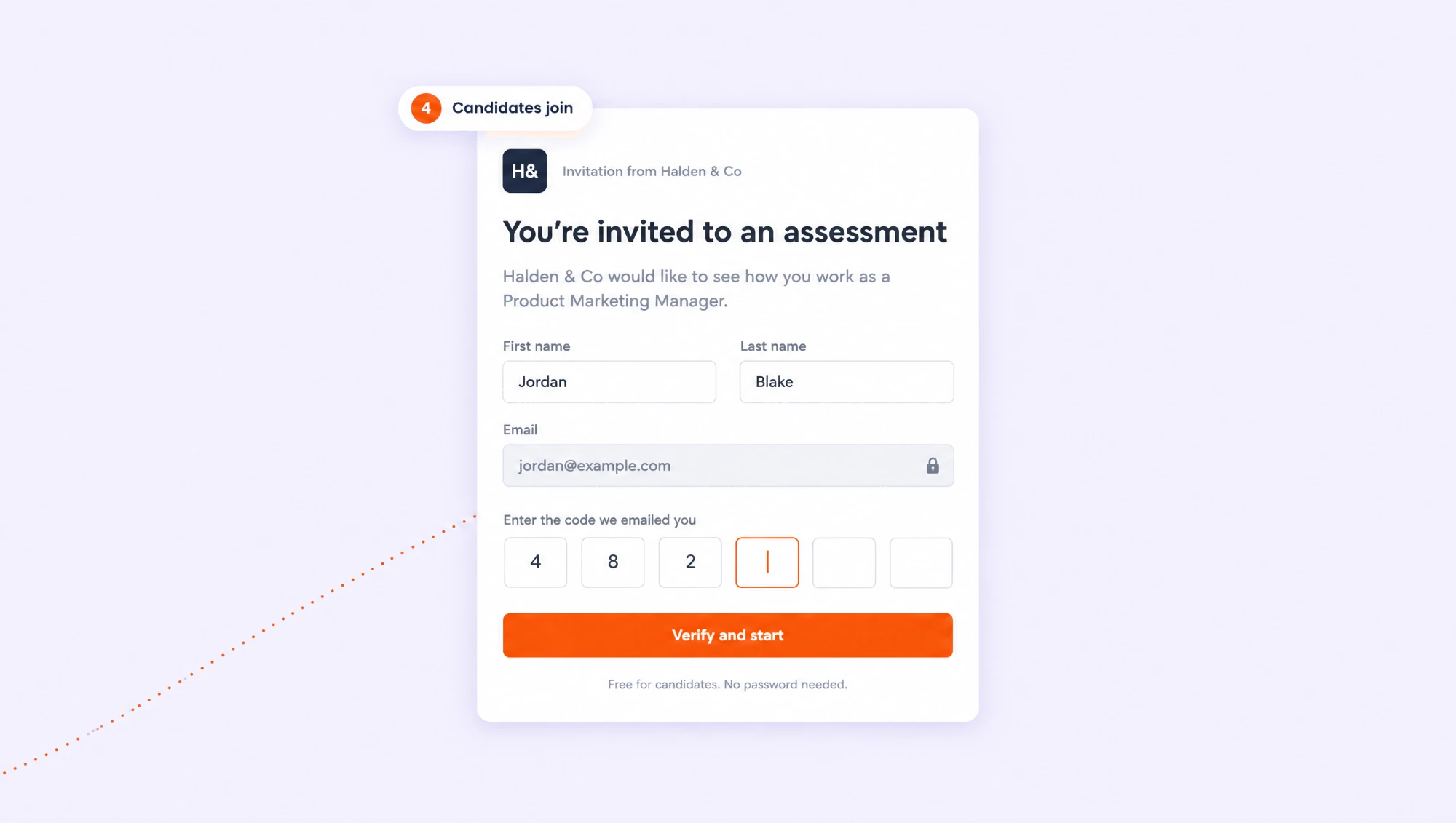
From your invite to their first task in a few steps.
Read the strongest candidates first
Capstone scores every candidate and ranks them, highest first, so the first reports you open hold the best work. You decide how far down the list to go. Each report has the score, the written evaluation, every task handed in and the feedback from their manager in the simulation, and downloads as a PDF for your panel.
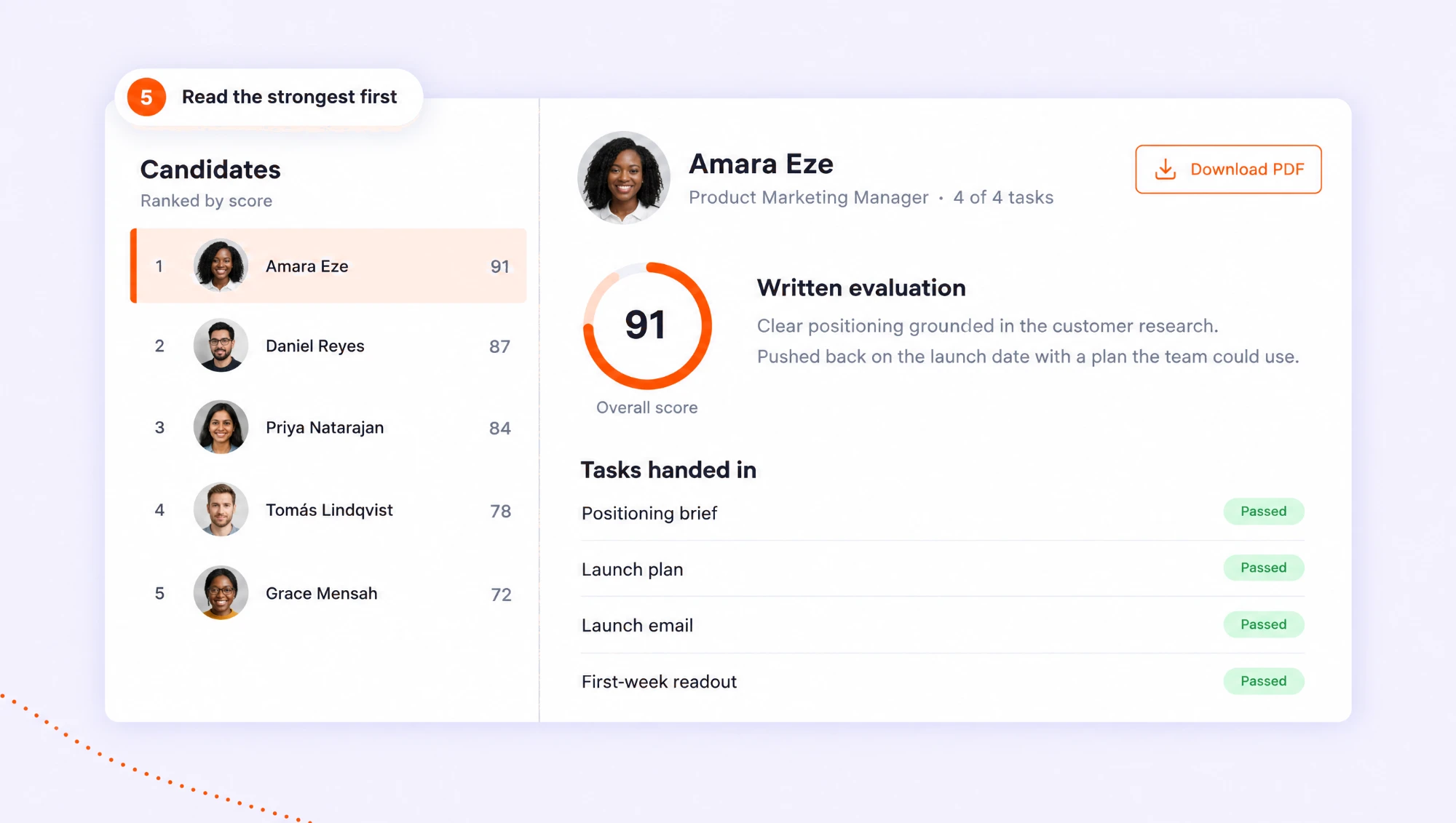
Candidates ranked by score, with the full report one click away.
Who it's for
You have an open role and no shortlist. Post the job with a simulation behind it, invite the promising applicants, and read their reports strongest first.
You already have a shortlist. The CVs look alike. A pre-employment assessment where everyone does the same work gives you something real to compare.
You're open to career switchers. A work sample test lets them show the skills their past job titles hide.
Fairness and candidate data
Same evaluation for everyone. Every candidate on an assessment gets the same company, the same tasks and the same evaluation.
Feedback goes both ways. Candidates get the same written evaluation you see, so the time they put in gives them something back.
Private by default. Results belong to your company and only show inside assessments it owns. Colleagues who sign up with your company email join the same account.
What it doesn't do
It doesn't screen CVs. You choose which applicants to invite, and Capstone ranks them once they've done the work.
It doesn't make the hire. It ranks candidates by score, and who moves forward is your call.
An assessment holds up to four tasks.
There's no candidate messaging, candidate search or trend charts over time.
It doesn't replace interviews. Use it alongside them.
Availability and pricing
Live now for any hiring team with a work email.
Building and publishing an assessment is free, and candidates pay nothing. Inviting candidates and putting a job live open after a short call: click Talk to sales in your dashboard. A simulation built around your own company is by request. Details are on the hiring page.
Get started
Sign up on the hiring page with your work email.
Click New hire and pick a path: Start with a job description or Create an assessment.
Paste your job description or describe the role, then pick the company.
Review the draft, edit anything and publish.
Click Talk to sales to book a short call that switches on invites.
Invite candidates, then read their reports, strongest first.
What we want to hear from you
Which non-technical role do you most want to assess next?
What would it take for you to swap your take-home for a simulation?
Tell us on the feedback page, or email hello@usecapstone.com.
FAQ
FAQ
- How do you assess candidates for non-technical roles?
Give them a slice of the real work and judge what they hand in, the same way for everyone. On Capstone that happens inside a simulated company, and you get a scored report on each candidate.
- What's a good alternative to take-home tests?
A work simulation assessment. Candidates work with a team in a simulated company while the brief shifts, and Capstone ranks them by score, so you see how they work without reading every file.
- Do candidates pay?
No. Candidates pay nothing. They open your invite, create a free Capstone account with their name and a one-time code, and start.
- How long does setup take?
You can sign up and publish an assessment in one sitting, because we draft the tasks. A simulation built around your own company is usually ready within a day.
- Which roles can I assess?
Any non-technical role, from product to customer support or sales. We draft the tasks inside whichever ready-made company fits best. For a simulation built around your own company, email us.
Sources
Sackett, Zhang, Berry and Lievens, Revisiting the design of selection systems in light of new findings regarding the validity of widely used predictors, Industrial and Organizational Psychology, 2023.
LinkedIn Economic Graph Research Institute, Skills-Based Hiring: Increasing Access to Opportunity, March 2025.
Keep reading
- pathways
- learners
- careers
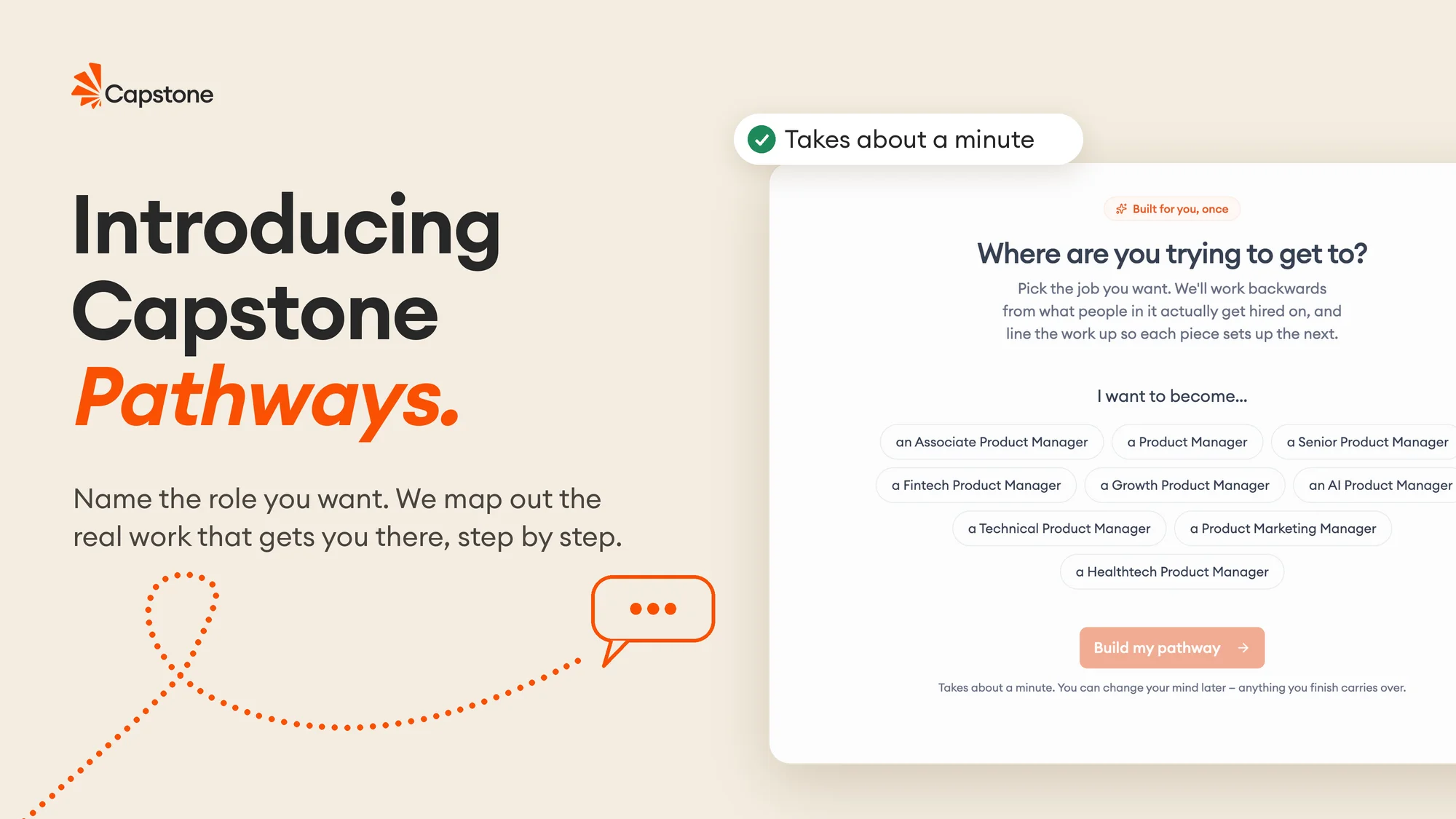
Tell us the role you want. We'll map the work that gets you there.
Name the role you want and get a personalised career roadmap: the skills to build, in order, each one practised as real work. Sold on its own.
- learners
- simulations
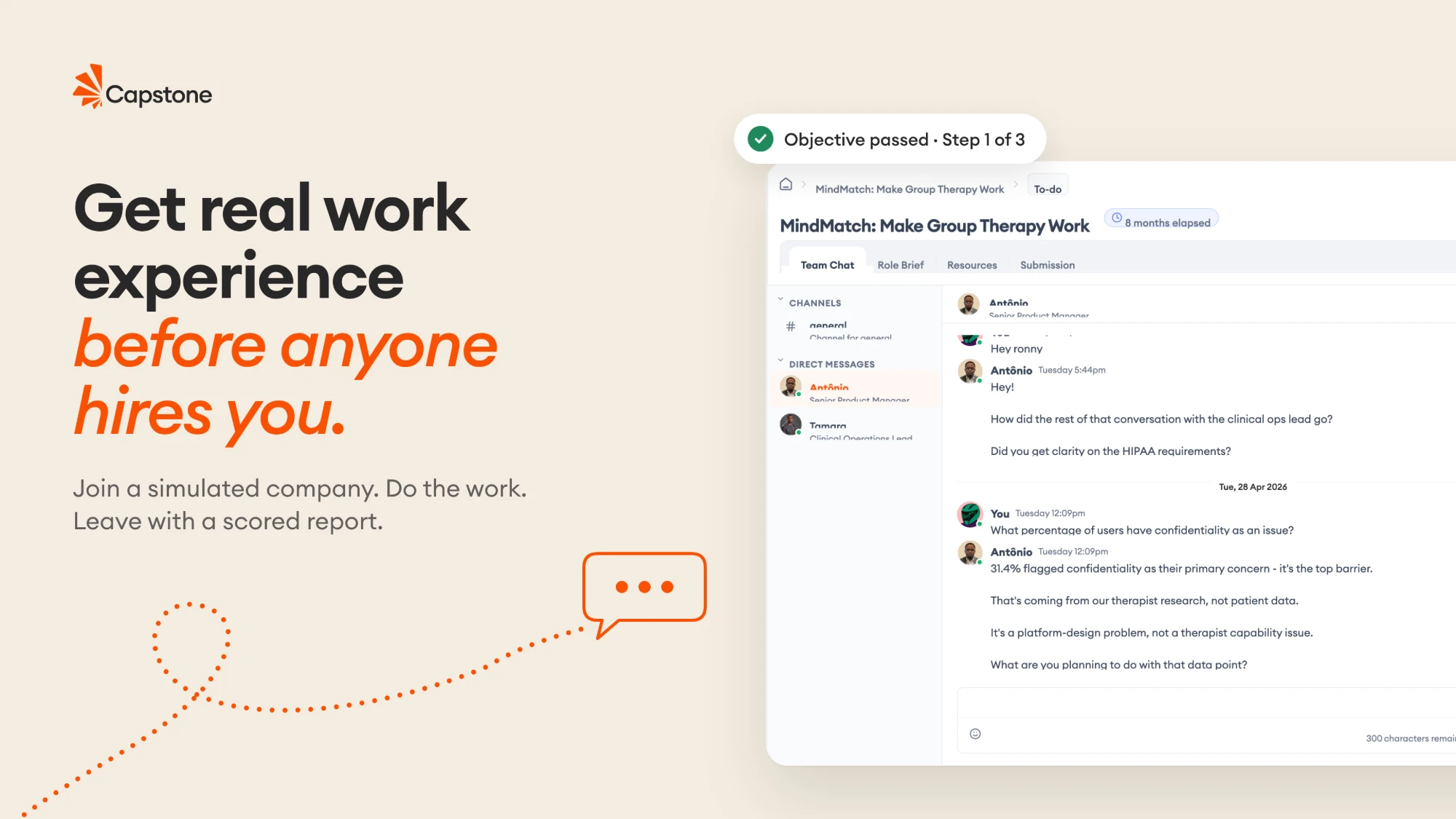
Get real work experience before anyone hires you
A Capstone work simulation gives career changers and graduates real work experience, a scored report and a certificate. 20% off with LAUNCH26.