What Hiring Managers Actually Score PMs On
Hiring managers don't score PM interviews on frameworks. They score judgment, execution, and influence. Here's the rubric behind every question
Updated Jun 11, 2026
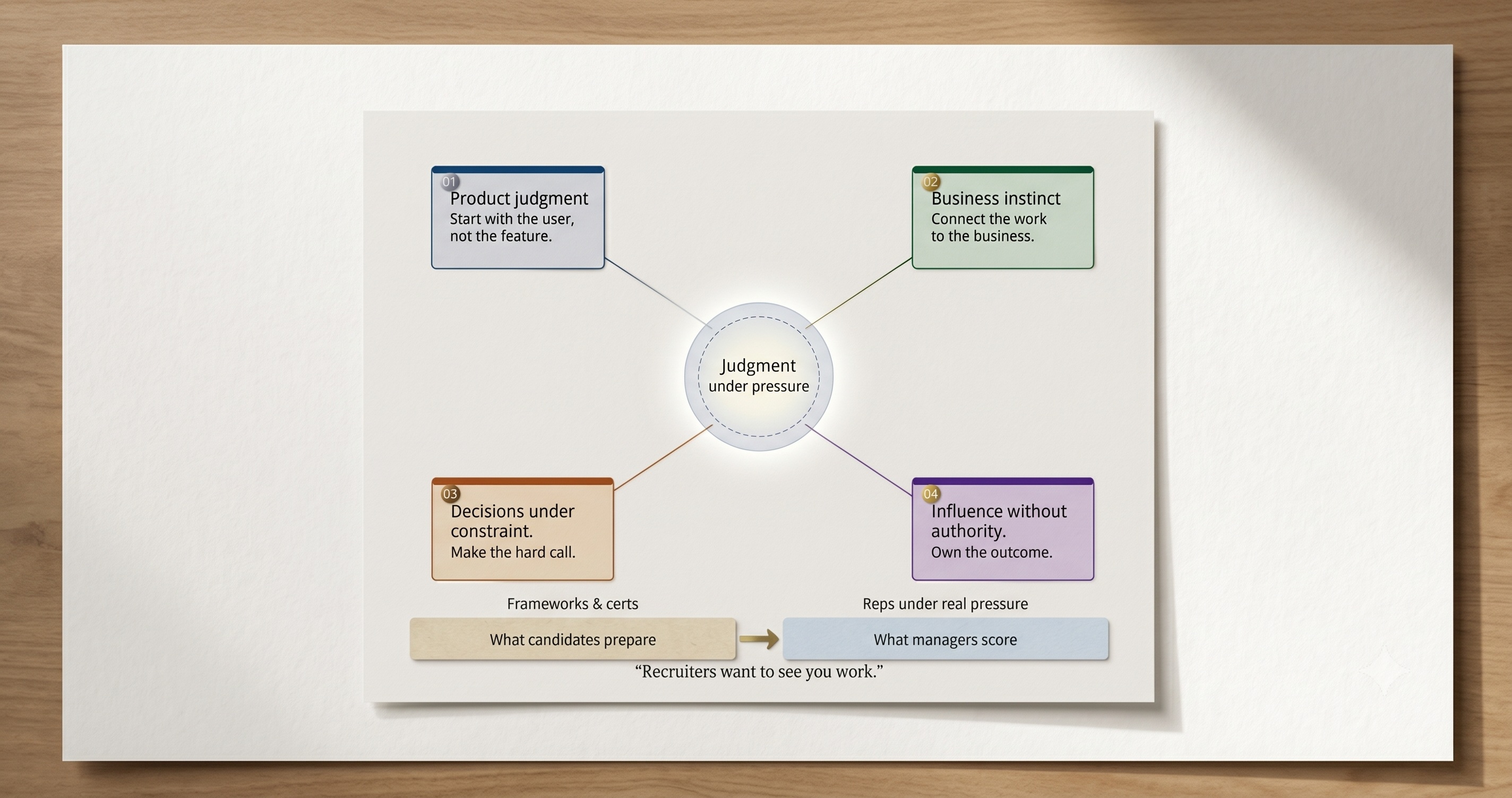
Hiring managers don't score how well you run a framework. They score judgment. Behind every interview question is a short rubric of competencies that cluster into four things: product judgment, decisions under constraint, influence without authority, and business instinct. You pass by showing real decisions and the trade-offs behind them, not by reciting a method.
You've read the interview books, watched the mock videos and memorized the frameworks. You walk in ready to run a clean, structured answer at whatever they throw at you.
That is the moment you lose the offer.
PM interviews look like tests of knowledge. They are tests of judgment. The hiring manager does not care whether you know the CIRCLES method. They care whether you can do the job when it gets hard. Frameworks prove you can study. Competencies prove you can build.
So the question that matters is not "what will they ask." It's "what are they scoring." Here is the rubric behind the questions.
Why the interview is a scorecard, not a conversation
A PM interview is risk mitigation. The hiring manager is trying to find out what happens when things go wrong, before they bet a roadmap on you. Each round maps to specific competencies. A behavioral round probes ownership and stakeholder management. A product round probes product sense and customer obsession.
The questions are just the delivery mechanism. Stop studying the question. Read the competency underneath it.
Those competencies sort into four clusters. Every hiring manager is marking you against all four.
1. Product judgment
This is the core muscle of the role, and it is three things working together. You start from the user's pain. You turn a vague problem into a scoped solution. You read the data instead of guessing.
Customer obsession shows up in how fast you bring the conversation back to the user. The common miss is jumping to a solution before you have named the failure it fixes. That tells the room you are attached to your idea, not the user's reality.
Product sense shows up when you are handed a vague prompt and you don't freeze. You segment, find the sharpest problem, and design against that one. Analytical thinking shows up when a metric drops and you break the funnel down to find the cause instead of theorizing about it.
Start with the user, not the feature.
2. Decisions under constraint
You will never have enough engineers or enough time. So the job is choosing what not to do, and living with it.
Hiring managers don't want to hear what you shipped. They want to hear what you killed, and why. Name the feature you cut, the segment you ignored, the date you protected, and the cost you accepted to protect it. Then show what happened when the plan broke: scope changed, the lead engineer left, legal said no on a Friday. They are watching whether your judgment survives pressure, or whether it only works on a whiteboard.
Make the hard call, and own the cost.
3. Influence without authority
A PM carries all of the responsibility and none of the authority. You have to move people who do not report to you.
They probe this with conflict. What do you do when sales has promised a feature you cannot build, or engineering pushes back on a date? Pulling rank is not an answer. Aligning incentives is. And when they ask about a failure, they are testing one thing: whether you take it, or hand it to the timeline, the market, or the engineers. The strongest candidates say plainly what they got wrong and what changed because of it.
Own the outcome, not the excuse.
4. Business instinct
Every product decision is a bet on the business. Strategic thinking is whether you can connect the feature in front of you to the number the company actually cares about.
They test it with a simple question: why does this matter to the bottom line? A weak answer describes the feature. A strong one ties it to retention, revenue, or a position that is harder for a competitor to copy six months out. Look past the current sprint.
Connect the work to the business.
The trap nobody warns you about
Here is the part that should worry you. You can know this entire rubric. You can name all four clusters and recognize every competency the second a question lands. And you can still walk out without an offer.
Knowing what is measured is not the same as showing it. The rubric lives in your head. The proof has to come out of your mouth, in real time, with someone pushing back. That is a different skill, and you cannot read your way into it.
This is why sharp candidates freeze on "tell me about a decision you owned." Not because they don't understand ownership. Because they have never had to make a real call, defend it to a stakeholder who disagreed, and live with the trade-off. They have knowledge. They don't have reps.
Recruiters do not want to see what you know. They want to see you work.
How to find out where you actually stand
You cannot grade your own judgment from a book. The only way to know how you score is to be put in the room and measured.
That is what a Capstone simulation does. You get reps as a PM inside a real company scenario. Stakeholders push back. Priorities shift. There is a PRD to ship and defend. You make the calls, and every decision gets scored against the same rubric senior managers use.
You've done the reading. Find out if you can do the job.
Come get measured {Enter Simulation}.